Brand Identity for Digital Products: A 2026 Strategy Beyond the Logo
How to build brand identity for digital products in 2026. Strategy, naming, visual systems, voice, and the actual operating manual that turns a brand into something a team can run.
7 min read
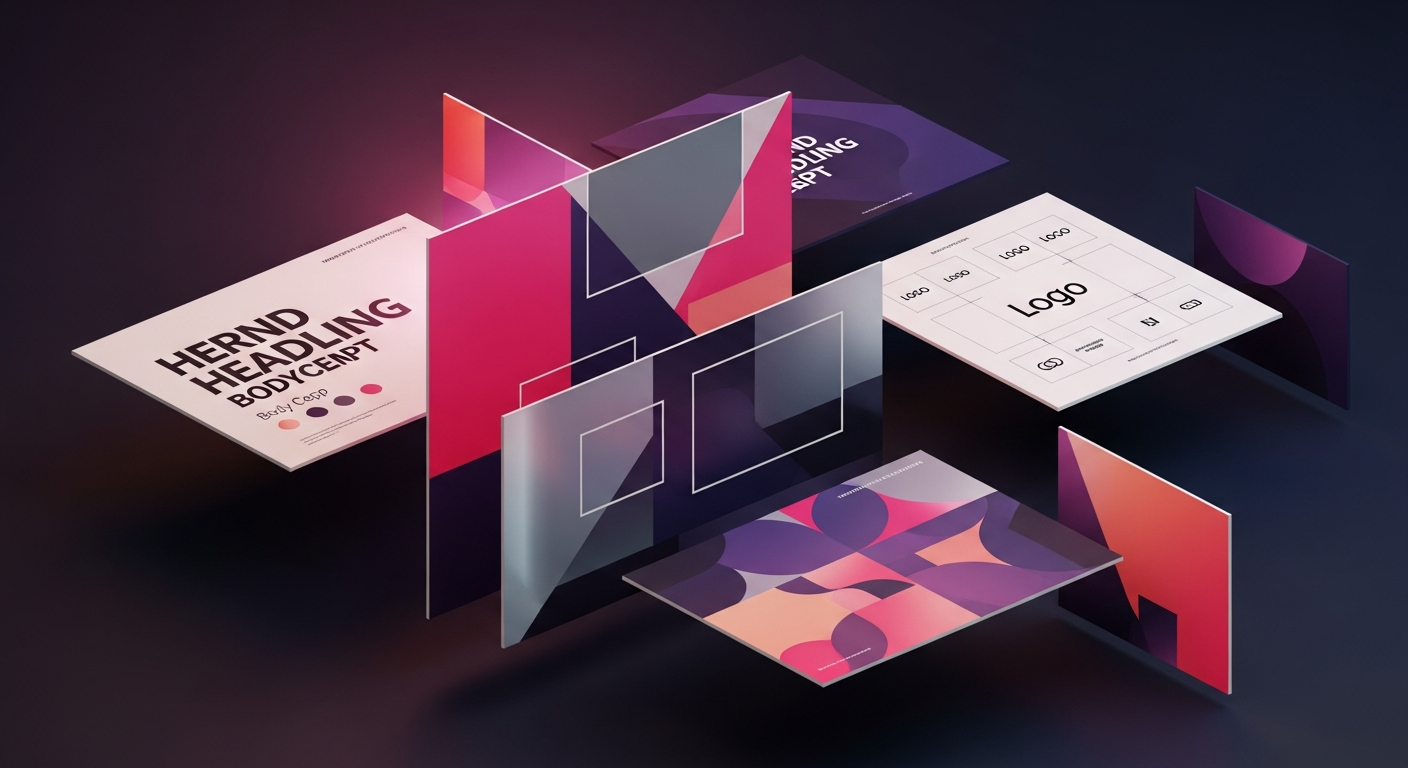
Brand identity has changed more in the last three years than in the previous fifteen. AI image generation made commodity logo work cheap. Voice and tone became something AI can replicate at scale. The brand book — once a 200-page PDF that lived in a Dropbox folder — is now a working operating system that has to ship code-level guidance for component libraries, motion, and AI prompts.
This article is for founders, marketing leaders, and brand consultants thinking about brand identity for digital products in 2026 — not just SaaS, but any company whose primary surface is a digital product (web app, mobile app, marketplace, ecommerce platform).
TL;DR — what brand identity actually means in 2026
Brand identity for a digital product in 2026 is seven things working together:
- Positioning and brand strategy — who you are, why you exist, against whom
- Verbal identity — name, tagline, voice, lexicon, content principles
- Visual identity — logo, color, type, imagery, iconography
- Digital expression — UI component library, motion, sound, micro-interactions
- Operating documentation — brand book that a team can use without the designer
- AI guidance — prompts and constraints for AI-generated assets and copy
- Measurement — brand health, sentiment, contribution to acquisition and retention
A brand that's just #3 (logo + colors) is decoration. A brand that's all seven is a competitive moat.
Why "logo + colors" is no longer enough
Three industry shifts in 2024-2026 made the old brand model obsolete:
1. Logo work became commodity. Midjourney and Imagen 4 generate technically competent logos in minutes. The differentiator moved from craft to strategy. A studio that sells you "we'll design 3 logo concepts" is selling 2018.
2. AI-generated content scaled brand voice problems. Any team can now generate hundreds of marketing assets per week. Without explicit voice guidelines, you get drift, inconsistency, and brand erosion at unprecedented speed. Voice documentation is now critical infrastructure.
3. Component libraries became the operational brand. For digital products, the brand lives in the actual UI components — buttons, cards, navigation, forms. A brand without a Figma component library + Storybook + tokens is unsynchronized with the product. Updates to one don't propagate to the other.
The 7 layers of modern brand identity
Layer 1: Positioning and brand strategy
Before any visual work, the strategic foundation:
- Who you serve (specific, not "everyone")
- What you do (the job done)
- Why you exist (the deeper purpose, when authentic)
- Against whom (your competitive set + how you differ)
- What you stand for (3-5 brand principles that drive decisions)
Time investment: 1-3 weeks of structured work with founders/leadership. Output: a 5-10 page strategy document that drives all subsequent decisions.
Skip this and the rest of the brand work is decoration on a missing foundation.
Layer 2: Verbal identity
The voice and language of the brand:
- Name (if pre-launch or rebranding)
- Tagline (the 5-word value statement)
- Voice (formal/informal, technical/accessible, serious/playful — usually 2-3 axes mapped on a spectrum)
- Lexicon (specific words to use; specific words to avoid)
- Content principles (the rules a writer follows when there's no direct guidance)
- AI prompt guidelines (how to prompt Claude/GPT to write on-brand)
Time investment: 1-2 weeks. Output: a verbal identity document with examples.
Layer 3: Visual identity
The visual system:
- Logo (and all variants: full, mark, monochrome, on-light, on-dark)
- Color system (primary, secondary, accent, semantic — with HSL/HEX/RGB and accessibility-checked combinations)
- Typography (display, body, monospace — with weight scales and usage rules)
- Imagery direction (photography style, illustration style, when to use each)
- Iconography (system, weight, sizing, when to use)
Time investment: 3-6 weeks. Output: visual identity document with all assets in usable formats.
Layer 4: Digital expression
The brand applied to digital surfaces:
- UI component library in Figma (not just designs — actual reusable components with variants)
- Token system (CSS variables for colors, spacing, typography that engineers consume)
- Motion guidelines (timing, easing, when to animate, when not to)
- Sound design (notification sounds, success states — usually for mobile apps)
- Micro-interaction patterns (hover states, focus states, loading patterns)
Time investment: 4-8 weeks. Output: production-ready Figma library + Storybook with engineer-consumable code.
Layer 5: Operating documentation
The brand book that a team can use without the designer being in the room:
- Strategy summary (what we stand for, what we don't)
- Voice and tone (with examples — always in pairs of "do this / not this")
- Visual system (with examples and rationale)
- Component library (referenced, with usage guidance)
- Production guidelines (how to make new assets, when to commission, when to AI-generate)
The biggest 2026 shift: the brand book is now a website, not a PDF. Living documentation that updates with the system.
Layer 6: AI guidance
New in 2026: brand operations include AI prompting guidelines.
- Voice prompting for Claude/GPT (voice context to inject in every prompt)
- Image generation prompting for Midjourney/Imagen (style references, what to avoid)
- Component generation (Cursor/v0 prompts that produce on-brand React)
- Banned outputs (specific words, visual treatments, tones to never produce)
Studios that ignore this layer let AI tools drift the brand within months.
Layer 7: Measurement
Brand work is invisible without metrics. The 2026 baseline:
- Brand awareness (unaided + aided survey, every 6 months)
- Brand search volume (your branded query trend in GSC)
- Direct traffic (a brand-strength proxy in GA4)
- NPS by source (do brand-driven users score higher?)
- Sentiment in social and reviews (manual or automated)
Without these, you can't tell if brand investment is working.
How to actually build brand identity (the operating model)
A 2026 brand identity engagement typically follows this rhythm:
Phase 1: Discovery (2-3 weeks)
- Founder/leadership interviews
- Customer research (5-15 interviews)
- Competitive audit
- Existing brand audit (if rebrand)
- Output: positioning brief
Phase 2: Strategy (2-3 weeks)
- Positioning workshop
- Brand archetype work
- Voice and messaging foundations
- Output: brand strategy document
Phase 3: Verbal identity (2-3 weeks)
- Naming (if needed)
- Tagline development
- Voice and tone documentation
- Lexicon
- Output: verbal identity document
Phase 4: Visual identity (4-6 weeks)
- Logo system
- Color system
- Typography
- Imagery direction
- Output: visual identity document with all assets
Phase 5: Digital expression (4-8 weeks)
- Figma component library
- Token system
- Motion guidelines
- Output: production-ready design system
Phase 6: Operating documentation (1-2 weeks)
- Brand book (web-first, not PDF)
- AI prompt guidelines
- Production playbooks
- Output: living brand site
Total: 16-24 weeks for full brand identity. Most companies don't need all phases at once — start with phases 1-3 (8 weeks, $20-40K), then add visual and digital expression as the product matures.
When to invest in brand vs. product
A common founder mistake: investing in brand before product-market fit. Brand built on hypothetical positioning becomes obsolete in 6 months when the product pivots.
Rules of thumb:
- Pre-PMF: minimal brand work — just enough to not embarrass the team. Spend $5-10K on a name, basic logo, and one-page positioning.
- Post-PMF, pre-Series A: invest in brand strategy and verbal identity ($15-30K). Hold off on heavy visual investment.
- Series A and beyond: full brand identity work ($50-150K) is justified — you have customers to learn from and traction to amplify.
- Established company / rebrand: full operating model ($100-300K) including measurement and team enablement.
Red flags when hiring brand work
- "We'll design 3 logos in week one." No strategy, no foundation. Decoration.
- No AI guidelines in deliverables. They haven't updated for 2026.
- PDF brand book. Not a working operating model.
- No component library. Brand and product will drift.
- No measurement plan. You can't tell if it's working.
- They show portfolio without strategy. Pretty marks, no thinking.
Green flags
- They start with positioning, not with mood boards.
- They want to interview your customers, not just your team.
- They show living brand systems, not finished PDFs.
- They have AI workflows for asset generation in their own work.
- They commit to measurement as part of the engagement.
- They tell you when you don't need brand work yet.
If you're considering brand identity work for your digital product, we offer a free 30-minute strategy call to discuss your stage and what level of investment makes sense. No upsell — just an honest read on whether brand is the right next investment for you.
Frequently asked questions
About the author
Design & Engineering Team
The UX Studio design and engineering team publishes practical notes on digital strategy, user experience, accessibility and implementation. The articles draw on work documented in the portfolio, including EduSpera, ClassWolf and the SupaSailing / SupaMaritime ecosystem.