Web Design in Florence 2026: A Guide for Founders, Boutique Hotels, and Luxury Brands
How to choose a web design studio in Florence in 2026. Pricing, multilingual SEO for the international market, sector specifics for fashion, hospitality, food & wine, and crafts.
7 min read
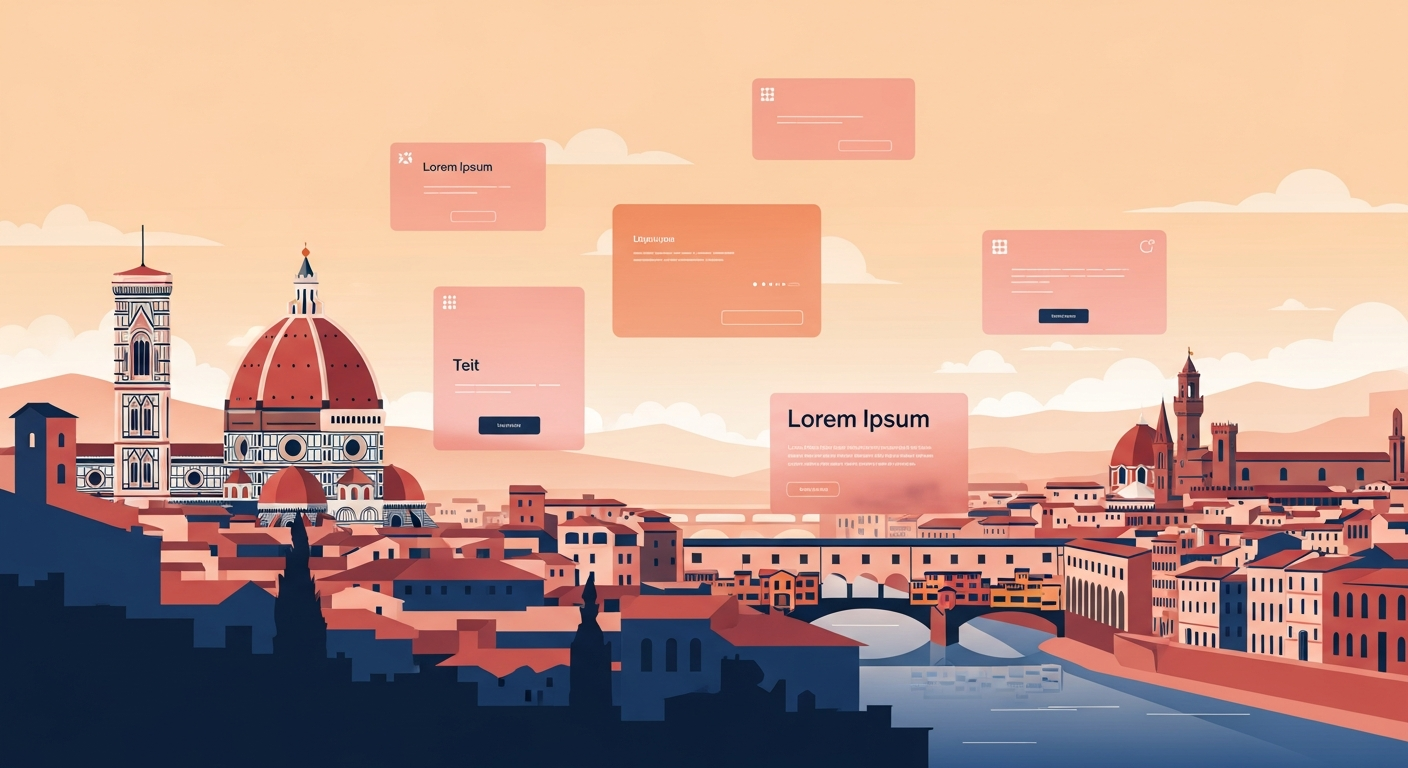
Florence is not Milan. It's not Rome. And it's not a second-tier digital market, despite what some Milanese agencies might suggest. It's a unique ecosystem where global luxury brands, artisanal workshops with international clienteles, 5-star hotels competing for demanding guests, and territory-rooted digital startups all coexist. Choosing the right web design studio here, in 2026, requires different thinking — especially if you're an international founder, hotel investor, or luxury brand based outside Italy.
This guide is written for English-speaking decision-makers — founders, marketing directors, hospitality owners — selecting a web design studio in Florence. The goal: avoid the three most common mistakes — paying too much for the wrong studio, paying too little for a site that needs rebuilding within a year, or wasting time on proposals that don't understand the Florentine market.
TL;DR — what to look for in a Florence studio in 2026
A solid Florence-based web design studio in 2026 should:
- Understand the international audience (English-speaking and German visitors often spend more than Italian clients)
- Have experience in at least one of the key sectors: fashion, hospitality, food & wine, crafts, cultural heritage
- Demonstrate case studies with metrics — conversions, bookings, sales — not just pretty pages
- Handle multilingual SEO (minimum Italian + English, often German or French too)
- Not be limited to design: they should know development, ecommerce platforms, booking systems
- Have a clear position on AI-assisted design in 2026 (not using it is a choice — but it must be argued)
Why Florence's digital market is a special case
Three factors make Florence different from Milan, Bologna, Rome, or Naples:
1. International clients are the majority of digital revenue. For boutique hotels in the historic center, leather brands by Ponte Vecchio, starred restaurants in Santo Spirito — Italian clients are a minority. A "Italian-only" website leaves 60-80% of conversions on the table. Florence studios that work integrate multilingual SEO from day one, not as an "add-on package."
2. Heavy seasonality. April-October concentrates 70% of organic traffic to the city. Sites must absorb peaks of bookings, orders, inquiries — and keep generating leads in low season (evergreen content, newsletters, territorial storytelling).
3. Local craftsmanship has enormous economic weight. Leather, tailoring, restoration, jewelry, art, publishing — Florence has thousands of small-medium artisanal businesses competing on global markets. A good Florentine studio must know how to tell the "made in Florence" story without sounding rhetorical to a Japanese or American customer.
Types of studios operating in Florence
Local freelancers (1-2 people)
- Typical price: €1,500-5,000
- Best for: simple showcase sites, landing pages, small local businesses
- Limit: capacity (a freelancer juggles 3-4 projects; if they get sick, your project halts)
- When to choose: tight budget, clear scope, flexible timing
Local boutique studios (5-12 people)
- Typical price: €6,000-30,000
- Best for: complex projects needing accompaniment and varied skills (design, development, SEO)
- Strength: know the market, speak the right languages, available in Italian working hours
- Weakness: sometimes lack vertical specialists (performance marketing, advanced data analytics)
Milan/Rome agencies serving Florence clients
- Typical price: €15,000-80,000
- Best for: hotel groups, established fashion brands, structured organizations
- Strength: solid processes, diverse team, experience with large clients
- Weakness: the "Florence client" is the exception in their book — risk of paying management overhead without dedicated attention
European/global remote studios
- Typical price: variable (€5,000-200,000)
- Best for: digital startups, SaaS products, international ecommerce without local roots
- Weakness: for traditional Florentine businesses (hotels, restaurants, artisans), they lose the territorial knowledge advantage
The 4 key sectors of Florence web design in 2026
1. Fashion, leather, and luxury craftsmanship
Historically Florence's strongest sector and the one with the largest digital budgets. A good site for a Florentine leather brand in 2026 should include:
- Storytelling of the know-how — you don't sell a bag, you sell the atelier, the master, 80 years of family history
- International ecommerce with configurable shipping, multi-country VAT handling, multi-currency payments
- Editorial photography optimized (AVIF, lazy loading, responsive art-direction)
- Product personalization when relevant (monograms, colors, materials)
- Video showing the workmanship — the real emotional hook for international clients
- Schema.org Product + Review for Google Shopping ranking
Typical case: a historic leather brand with 40 products converts 2-3x more when the site narrates the atelier rather than listing products as a generic ecommerce catalog.
2. Tourism and quality hospitality
Boutique hotels, relais, Chianti agriturismi, period residences — all compete for visibility on Google Maps, Booking.com, TripAdvisor. Design priorities in 2026:
- Direct booking without OTA commission (PMS integration like Cloudbeds, Mews, SimpleBooking)
- Professional photography (not renders, not stock, not phone) as the experience backbone
- Territorial storytelling — tourists don't book a room, they book a Tuscany experience
- Schema.org LodgingBusiness with rich-results optimization
- Minimum versions in Italian + English + German (DACH market is crucial for Tuscany)
3. Food & wine and DOP products
Chianti wines, Brunello olive oil, pecorino toscano, salumi — Tuscan food digital market grows 20% annually. What's needed:
- Shopify for catalogs up to 500 SKU, WooCommerce or Magento for complex catalogs
- Cold-chain logistics when relevant (wine, fresh salumi)
- Subscriptions when the model allows (wine of the month, seasonal mixed case)
- Terroir narration — denomination of origin, methods, territory, family history
- Long-tail SEO on recipes, pairings, wine guides
4. Signature crafts and cultural heritage
Restorers, luthiers, ceramicists, fountain pen makers, antiquarian booksellers — niche market with demanding global clientele. Priorities:
- Visual credibility (curated photography, testimonials, references)
- Lead capture via well-designed forms + integrated CRM
- Technical blog for authority positioning (techniques, history, guides)
- Multilingual versions minimum Italian + English
How to evaluate a studio in 5 meetings
Meeting 1 — Intro (30 min): present your business; the studio presents itself and 2 relevant case studies. Critical question: "Have you worked with Florentine companies in my sector? Show me." If the answer is vague, red flag.
Meeting 2 — Case study deep dive (45 min): ask them to walk you end-to-end through a sector-similar case. What problems, what decisions, what metrics moved after launch. Listen for concrete results, not just "it turned out beautiful."
Meeting 3 — Meet the team (30 min): the designer and developer who'll actually work on the project — not the sales director. If the studio resists, huge red flag.
Meeting 4 — Proposal + discovery sprint (60 min): a serious studio doesn't send a complete quote without discovery. They'll propose 1-2 paid weeks (€2,000-5,000) with clear deliverables.
Meeting 5 — Closing (30 min): after discovery, definitive proposal with phases, prices, timelines, milestones. Decision time.
Florence-specific red flags
- They can't explain multilingual SEO. Ask how they handle hreflang, canonical, duplicate content across IT/EN/DE. If they hesitate, you'll see it.
- Italian-only team. If there's no native English speaker (or someone with solid C1-C2) on the team, they can't validate the quality of translations and copy in English.
- WordPress for everything. WordPress is fine for editorial sites; for serious ecommerce or a booking platform, it's probably not the optimal 2026 choice.
- No mention of performance. A significant slice of Florence traffic comes from smartphones on the move (tourist looking for a restaurant from a piazza). A slow site loses 40% of users before load.
- No Florentine portfolio. Not a deal-breaker if they have a strong portfolio elsewhere, but ask how they adapt to local context.
The 3 most common hiring mistakes in Florence
1. Picking the cheapest to save money. In web design, cheap almost always means "rebuild in 12-18 months." The difference between a mediocre and a good studio is €3,000-8,000 — negligible compared to the revenue a well-built site generates over 3-5 years.
2. Not investing in discovery. Skipping discovery saves €3,000 and costs you €30,000 in scope changes during the project. Always, always pay for discovery.
3. Confusing "beautiful" with "converts." A beautiful site that doesn't convert is a portfolio, not an asset. Prioritize studios that talk about metrics, flows, data — not only aesthetics.
Final questions for decision day
When choosing between two or three finalists, ask yourself:
- Do I trust they'll understand my business, not just execute Figma?
- Would I want to work with these people when something goes wrong?
- Are they curious about my problem, or selling me their template?
- Did they respond fast and well during the sales phase? If not, it gets worse during delivery.
A project lasts 3-12 months. You're hiring people, not portfolios.
If you're evaluating studios in Florence right now and want a second opinion on your shortlist, we offer a free 30-minute call to review your brief. No upsell — just an honest analysis from a studio that knows the Florentine market.
Frequently asked questions
About the author
Design & Engineering Team
The UX Studio design and engineering team publishes practical notes on digital strategy, user experience, accessibility and implementation. The articles draw on work documented in the portfolio, including EduSpera, ClassWolf and the SupaSailing / SupaMaritime ecosystem.