How AI Automations Are Reshaping SaaS Onboarding in 2026
A practical guide to integrating AI agents into SaaS onboarding flows — boost activation rates, cut time-to-value, and turn first-touch users into long-term customers.
5 min read
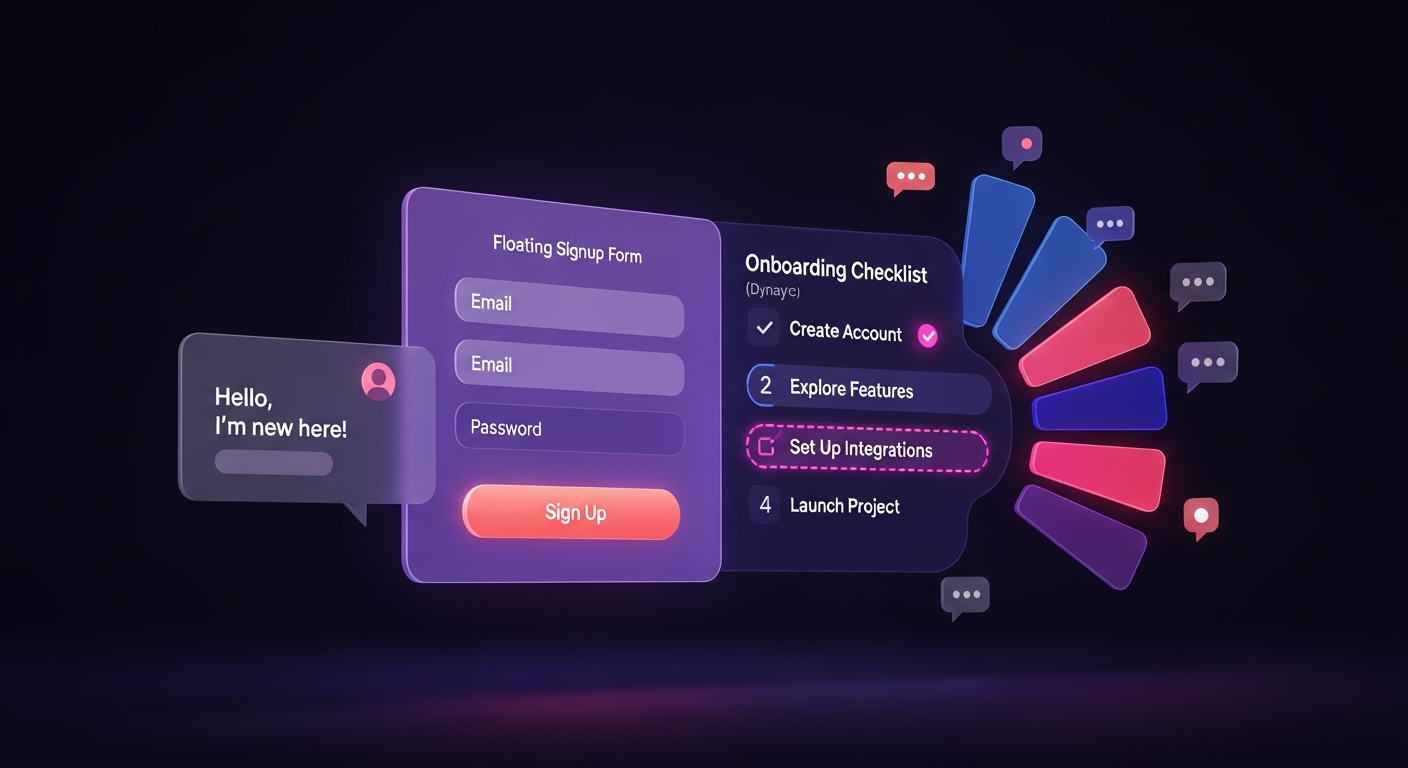
Onboarding has always been the most expensive moment in a SaaS product's lifecycle. It's where you spend the most attention per user, and where 60-80% of trial users decide whether to ever come back. In 2026, AI agents are quietly rewriting the rules of how that moment plays out.
This isn't about adding a chatbot. It's about replacing the "set up your account" wizard with an agent that actually does the work for the user.
The old onboarding playbook is broken
For years, the standard SaaS onboarding consisted of:
- A welcome email
- A product tour with tooltips
- A checklist of "first steps"
- An empty dashboard waiting for the user to fill it
- A nudge email if the user didn't activate within 24 hours
This worked when SaaS products were simple. But today's tools — analytics platforms, CRMs, design systems, ops dashboards — require dozens of decisions before a user sees value. Every decision is a potential drop-off point. And the user has 12 other tabs open.
The data backs this up: a 2025 Mixpanel study found median activation rates for B2B SaaS products dropped from 41% in 2020 to 27% in 2025, despite onboarding being a top investment area for product teams. The friction added by feature richness has outpaced the friction removed by better UX.
What AI agents change
An AI agent in the onboarding flow can do three things a tooltip cannot:
- Understand intent. When a user lands on your dashboard for the first time, an agent can ask "what are you trying to accomplish?" and parse a free-form answer.
- Take action. Based on that answer, the agent can pre-configure the product — connect data sources, create the right workspaces, invite the right team members, populate templates.
- Adapt in real time. As the user clicks around, the agent observes and offers context-aware suggestions, instead of triggering generic tooltips on a fixed schedule.
The result is an onboarding that feels like having a senior customer success manager sitting next to you, except it scales to a million users.
A reference architecture for AI onboarding
After shipping AI onboarding flows for several SaaS clients, here's the architecture pattern that consistently works:
1. The intent agent
Triggered immediately after signup. Asks a single open-ended question:
"In one sentence, what do you want to do with [product name] this week?"
The user's answer is parsed by an LLM into a structured intent object: goal, vertical, role, urgency. This becomes the seed for everything that follows.
2. The setup agent
Takes the intent and runs a multi-step plan. For a marketing analytics product, that might be:
- Detect the user's tech stack from their email domain
- Pre-create the right dashboards
- Suggest integrations to connect
- Populate sample reports based on the user's vertical
The user sees a single screen: "We've set up your workspace based on what you told us. Want to take a look?" — instead of a 12-step checklist.
3. The guidance agent
Watches the user's behavior post-setup. If they hover on a feature for 5 seconds without clicking, the agent surfaces a one-line tip. If they get stuck, it offers a "show me how" interactive walkthrough. No generic "Did you know?" popups.
4. The handoff agent
Knows when to step back. If the user is moving fast and clicking confidently, the agent stays silent. If the user is struggling repeatedly on the same feature, it offers a session with a real human (your CS team or sales team) — with the agent's context already pre-loaded.
Three patterns that consistently win
Across the projects we've shipped, three implementation patterns have separated successful AI onboarding flows from gimmicky ones:
Pattern 1: One question, no forms
The fastest activation flows we've seen replace a multi-step signup form with a single question and intelligent defaults. The agent infers everything else.
Pattern 2: Pre-populate, don't ask
Instead of asking the user to invite teammates, the agent suggests names from their email domain or LinkedIn. Instead of asking for industry, it infers from the company name. Every form field replaced with an inference is a 5-10% lift in completion.
Pattern 3: Show the value before asking for commitment
The best AI onboarding flows let users experience the product before asking them to log in repeatedly, set up billing, or complete tedious configuration. The agent populates a working version of the product first, then asks the user to commit.
The risks (and how to mitigate them)
AI onboarding is not without risk. The three failure modes we've seen most often:
Hallucinations in the setup phase. If the agent fabricates a connection or a data source that doesn't exist, the user loses trust instantly. Mitigation: ground every agent action in actual API responses; never let the agent "describe" a state it didn't verify.
Over-asking. Some teams overcorrect and have the agent ask 5-10 questions before doing anything. This kills the speed advantage. Mitigation: limit the agent to one question per flow; infer everything else.
Privacy debt. Users now share more context with your product than ever (job role, goals, tech stack). If you store this without consent or leak it to third-party LLM APIs, you create regulatory and reputational risk. Mitigation: explicit consent at signup, on-prem or private-model inference for sensitive data, and clear data retention policies.
What to measure
If you're shipping AI onboarding, track:
- Time to first action (TTFA) — how long from signup to first meaningful action. Target: under 60 seconds.
- Activation rate — % of users who complete a defined "aha moment" within 7 days. AI onboarding should lift this by 25-40%.
- Question reduction — how many fewer support tickets/onboarding questions you receive. Target: 50%+ reduction within 90 days.
- Trust score — survey users at day 7: "Did the AI agent feel helpful or annoying?" Anything below 4/5 needs investigation.
The bottom line
AI onboarding isn't a feature you add to a product. It's a re-architecture of how your product introduces itself to a new user. Done well, it removes the cognitive load that has been slowly killing SaaS activation rates for the last five years. Done poorly, it's a more expensive version of the chatbot pop-up nobody ever wanted.
The companies winning right now are the ones treating AI onboarding as a product surface, not as a marketing wrapper.
Frequently asked questions
About the author
Design & Engineering Team
The UX Studio design and engineering team publishes practical notes on digital strategy, user experience, accessibility and implementation. The articles draw on work documented in the portfolio, including EduSpera, ClassWolf and the SupaSailing / SupaMaritime ecosystem.