Hotel Website Design 2026: 10 Patterns That Win Direct Bookings
How modern boutique hotels and hospitality brands design their websites to convert direct bookings in 2026. Booking engine UX, multilingual flows, OTA disintermediation, and the patterns that work.
6 min read
The hotel website is one of the most expensive things a property owns and one of the most under-designed surfaces in hospitality. In 2026, the gap between hotels that convert direct bookings well and those that funnel 80% of revenue to Booking.com is wider than ever — and the design decisions that close the gap are well-understood.
This article distills the patterns that work in 2026, based on what we've shipped and seen ship for boutique hotels in Mallorca, Tuscany, and other premium markets. Some are universal; some are specific to leisure, business, or resort properties.
TL;DR — what works in 2026
A modern hotel website in 2026 needs:
- Integrated booking engine styled to match the brand
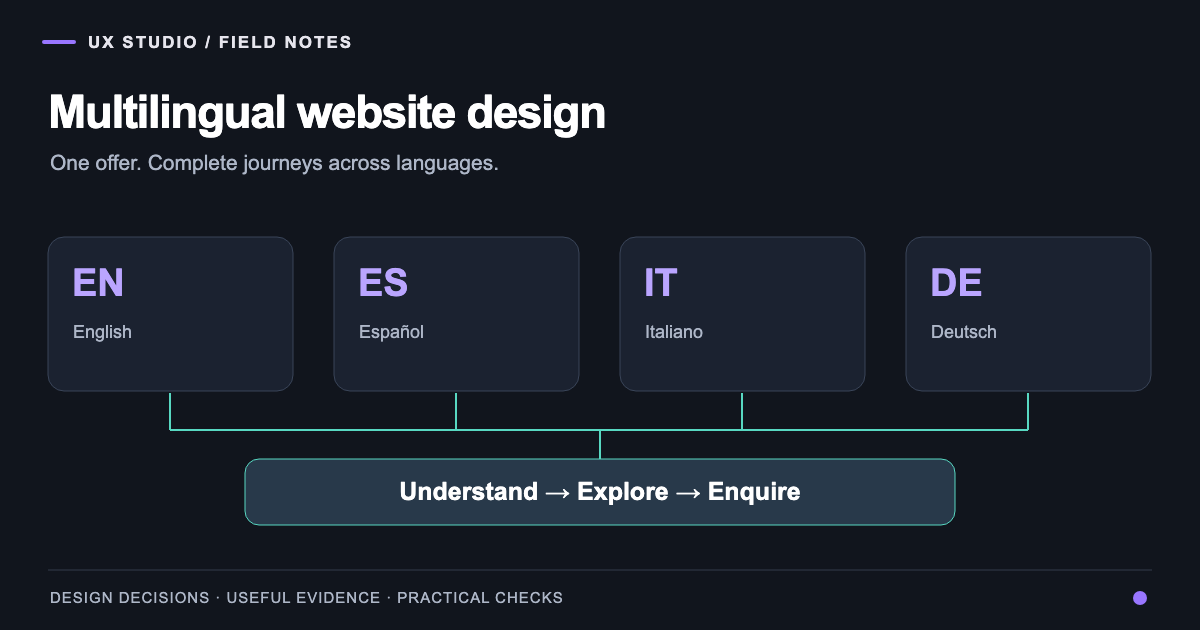
- Multilingual UX in at least the 3 most relevant languages for your market
- Hero photography and video as primary content
- Instant rate visibility (no quote-only)
- Direct-booking incentive clearly stated
- Mobile-first design (most bookings start on phones)
- One-tap WhatsApp + email contact
- Trust signals (reviews, certifications, awards) prominent
Why hotel website design is uniquely hard
Hotel UX has constraints that don't appear in other travel sectors:
1. Inventory is multi-dimensional. Rooms aren't just rooms — they have view, floor, balcony, accessibility, smoking/non-smoking, bed configuration. Modern booking flows handle this without overwhelming the user.
2. Pricing is dynamic and complex. Daily rates, length-of-stay restrictions, package deals, cancellation policies, taxes, fees — all combine into a final price that's often 20-30% higher than the headline rate. UX must build trust through transparency.
3. Trust is the deciding factor. Booking a hotel involves committing $200-3,000 to a property the user hasn't seen. Trust signals matter more here than for almost any other category.
4. Competition includes giants. Booking.com, Expedia, Hotels.com, Airbnb — your direct competitors include some of the most UX-sophisticated companies in the world. Hotel websites must match or exceed their booking flow quality, or they lose direct bookings to them.
The 10 patterns that win direct bookings in 2026
1. Integrated booking engine
The booking engine must look and feel part of the website, not a separate tool. The pattern: deeply themed booking widgets from SiteMinder, Cloudbeds, Mews, or D-EDGE — not iframes that break visual continuity.
The conversion cost of broken visual continuity: typically 15-30% drop-off at the moment of clicking "Book Now."
2. Hero video over hero photo
For premium properties, a 5-10 second looped hero video showing the property in motion (sea waves, candles, dining service, pool ripple) outperforms even the best static photo for emotional engagement.
Format: H.264 baseline at 720p, under 2MB, autoplay muted, with a high-quality fallback poster. Lazy-load below the fold.
3. Inline rate visibility
The user wants to know if they can afford to stay. Show rates inline as soon as dates are selected. Don't gate behind login or "request quote".
The 2026 standard: rate visible within 2 seconds of date selection. Anything slower loses to OTA experiences.
4. Best-rate guarantee that's actually honored
If your direct booking isn't the cheapest, no design pattern saves you. The starting point: lower direct rate than OTA rate by 5-10%, plus an additional perk (free breakfast, room upgrade, late checkout).
Then say so prominently. "Book direct for the best rate — guaranteed" is the most-tested headline in hotel direct booking and still the most effective.
5. Multilingual booking flow
The booking flow itself — not just marketing pages — must be in the languages your guests speak. For Mediterranean properties: ES + EN + DE minimum. For Tuscany: IT + EN + DE + FR. For Caribbean: EN + ES + FR.
Auto-translated booking flows fail trust at the moment of payment commitment.
6. Mobile-first reality
Over 60% of hotel website visits start on mobile in 2026. Most users research on mobile, then complete booking on desktop — but if the mobile experience is weak, they switch to OTAs entirely.
Specific mobile requirements:
- Booking widget visible above the fold without zoom
- One-thumb operation for date and room selection
- WhatsApp contact one tap away
- Photos that load progressively, not block content
- Phone-call CTA visible on every page
7. Trust signals at every step
Reviews and ratings need to be visible at:
- Hero (TripAdvisor/Google rating overlay)
- Room cards (recent guest comments)
- Booking confirmation page (testimonials)
- Email confirmations (review snippets)
Plus: certifications (sustainability, accessibility), awards (Michelin, Leading Hotels), professional memberships (Relais & Châteaux).
8. Photography that respects the property
Most hotel websites use 6-15 photos per room. Premium properties should use 25-50, organized into clear categories (room, bathroom, view, amenities, common areas, dining, exterior).
The 2026 standard photo spec: 4K source, optimized to AVIF/WebP, lazy-loaded, with proper alt text. Drone footage for resorts. Virtual tour for luxury properties.
9. Direct contact alternatives
Some users want to talk before booking. Provide multiple paths:
- WhatsApp (Mediterranean, Latin American, increasingly global)
- Phone (with international number formatted per country)
- Email (with response-time promise)
- Live chat (during peak hours)
- Calendar booking for sales calls (group bookings, weddings, events)
The pattern: visible from every page, never hidden in a footer.
10. Post-booking experience
The booking confirmation isn't the end of UX — it's the start. Post-booking design should include:
- Beautiful confirmation email with all relevant info
- Pre-arrival communication (3-5 days before, with check-in details, local recommendations, optional add-ons)
- Mobile-friendly check-in (some properties now offer remote check-in via app/SMS)
- Stay-companion content (in-room tablet or web-based concierge)
- Post-stay review request (well-timed, not pushy)
Each touchpoint is a brand opportunity and a future-booking driver.
Booking engine choice in 2026
The booking engine you choose constrains your website design more than any other technical decision. The 2026 leaders:
| Engine | Best for | Strengths |
|---|---|---|
| Cloudbeds | Boutique under 100 rooms | Modern UI, integrated PMS, easy setup |
| SiteMinder | Mid-market 50-300 rooms | Most flexible, channel manager included |
| Mews | Boutique to mid-market | Modern UX, growing in Europe |
| D-EDGE | International chains | Strong in Asia, multilingual |
| Hotelogix | Budget-conscious | Affordable, decent feature set |
| Built.com | High-end | Beautiful UI, premium pricing |
Avoid: generic ecommerce platforms (Shopify, WooCommerce) — they don't handle hotel inventory correctly. Avoid 2010-era PMS-bundled booking engines that look outdated and don't theme well.
Common mistakes in hotel website design
- Booking widget that doesn't match the brand. Single biggest conversion killer.
- Hidden rates. "Request a quote" buttons in 2026 = users bounce to OTAs.
- Stale photography. Photos from 2018 of a renovated property destroy trust.
- Single-language booking flow when guests are international.
- Slow mobile. Mobile LCP over 4 seconds = 60% bounce.
- No best-rate guarantee. Why should I book direct vs. Booking?
- Hidden direct-booking perks. If you offer free breakfast for direct, say so 5 times.
How to evaluate a web partner for your hotel
The same general framework as any project, with hotel-specific questions:
- Have you integrated with [your booking engine]?
- Have you built multilingual booking flows?
- How do you handle dynamic pricing display?
- Can you show me a hotel website you've built that's currently live?
- How will you ensure the booking engine theme matches the website design?
Strong sign: they have hotel-specific case studies. Weak sign: they show generic "hospitality" portfolio without hotel-specific examples.
If you operate a hotel and want a UX/conversion audit of your current site, we offer a free 30-minute consultation. We'll identify the biggest leaks in your direct-booking flow and propose a roadmap. No upsell — just an honest assessment.
Frequently asked questions
About the author
Design & Engineering Team
The UX Studio design and engineering team publishes practical notes on digital strategy, user experience, accessibility and implementation. The articles draw on work documented in the portfolio, including EduSpera, ClassWolf and the SupaSailing / SupaMaritime ecosystem.