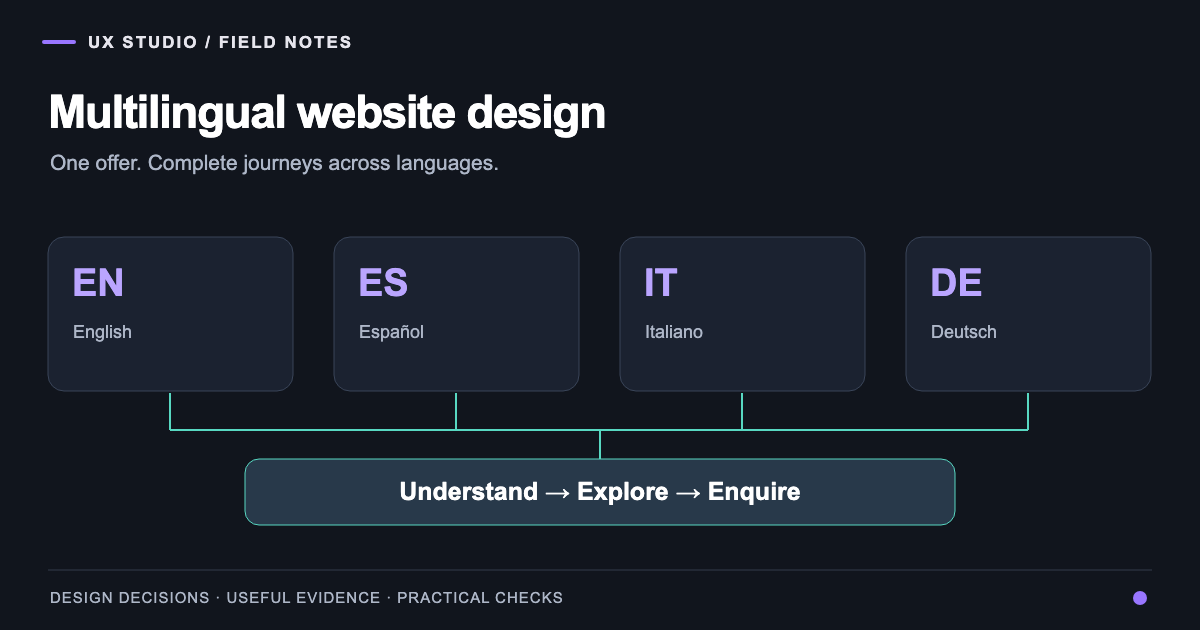
SEO in Mallorca: Map Markets, Intent and Languages
Build a multilingual SEO strategy for a Mallorca business with audience evidence, keyword intent, page mapping and measurement rather than assumed demand.
4 min read
A multilingual SEO strategy connects an audience, a search need and a useful destination in each relevant language. For a Mallorca business, the starting point is the work it actually sells and the customers it can serve, rather than an assumed island-wide percentage of foreign traffic.
A visitor researching a holiday, a resident comparing professional services and a buyer considering a property can all search for Mallorca-related information. They need different explanations and next steps. The strategy should make those distinctions visible in the content plan.
Our Mallorca web design practice connects that planning to a usable website. This article covers markets, keyword evidence and page decisions. The multilingual website implementation brief covers the complete language journey, including forms and maintenance.
Define the audience before the language list
Start with enquiry records, customer conversations and the team's capacity to provide a service. Identify where someone is when researching, what they need to decide and who will answer them. A language is worth planning when the business can offer useful content and a credible follow-up.
Do not equate nationality with language preference. Nor should a business assume that the largest audience is automatically its most valuable one. A specialist service with a narrow, relevant audience may need a more focused content plan than a broad visitor guide.
Write down the assumptions. If the business believes German-speaking customers need a particular service, identify what evidence would confirm it. That is a research question, not a market fact to insert into every page.
Build a dated keyword evidence sheet
For each candidate query, record the source, collection date, target country, language settings and search intent. Search-volume estimates are useful context, not a forecast of visits or enquiries. Advertising competition is also a different measure from organic ranking difficulty.
We keep missing estimates visible rather than replacing them with invented numbers. A low-volume term can still describe a valuable customer problem. Conversely, a large estimate can refer to an audience the business does not serve.
The following phrases illustrate a mapping exercise; they are not a verified ranking or volume report:
| Example query | Likely task to investigate | Potential destination |
|---|---|---|
| web design mallorca | Find and evaluate a local provider | Commercial service page |
| diseño web multidioma | Understand a multilingual website project | Implementation guide |
| hotel website redesign | Plan a change to an existing site | Redesign checklist |
| yacht charter website design | Evaluate a specialist website brief | Sector-specific guide |
| interior designer mallorca | Find an interior designer | The designer's own service website |
The final row matters: an agency article should not compete for an end client's service query simply because that client appears in its portfolio. The agency can explain its website decisions while preserving the distinction between businesses.
Give each intent one clear destination
Separate hiring intent from learning intent. A service page should explain the offer, relevant experience and how to start. A guide should help someone make a decision. A case study should provide inspectable work and describe the contribution accurately.
For example, Daniela La Rosa's website case study demonstrates positioning, visual direction and implementation. It supports the studio's experience; it does not turn UX Studio into an interior design service. Contextual links help visitors move between those different page purposes.
Where several pages answer substantially the same question, review their roles before adding another. Without search-performance evidence, this is a potential overlap to investigate, not proof that a particular page is suppressing another's rankings.
Choose a maintainable language architecture
Distinct language URLs make pages easier to share, review and connect. Google's international-site guidance describes multiple structures and their trade-offs. Subdirectories can be convenient for one team; separate domains or subdomains create different operational responsibilities. There is no need to declare one structure universally correct.
For implementation, maintain a map of equivalent pages and review language alternatives. Link to a genuine translation when it exists. Avoid implying that a partly translated template provides the complete experience of another language.
Translation tools can assist drafting, but someone must verify terminology, scope and meaning. Google's guidance on generative AI content emphasises accuracy and value, and warns against scaled publication without useful substance. Tool choice alone does not establish the quality of a translated page.
Keep local business information accurate
A local page should clarify the actual service area and whether meetings happen locally or remotely. Do not invent an office to support a city keyword. Keep the business name, contact details and any published address consistent with the real operation.
Google's local-ranking guidance recommends complete, accurate business information and explains that local results use several factors. It does not promise a better position from a fixed posting schedule. A Business Profile, where appropriate, complements the website; it does not replace clear service content.
Measure the pages and enquiries that matter
Use Search Console's performance reporting to examine queries, pages and relevant segments over a recorded period. Compare that with landing-page behaviour and qualified enquiries. These are different measurements, and none alone explains why a person chose the business.
Record changes before drawing conclusions. Seasonality, campaigns and a change in the offer can affect results alongside website work. A manual search is an observation made under particular conditions, not a universal local ranking.
A useful first delivery is therefore a market-and-intent map, a list of pages to improve and an agreed way to evaluate them. Our digital strategy service connects those decisions to delivery. For discovery in generative search, the AI search optimization guide applies the same discipline: useful evidence, reliable access and measured claims.
Frequently asked questions
About the author
Design & Engineering Team
The UX Studio design and engineering team publishes practical notes on digital strategy, user experience, accessibility and implementation. The articles draw on work documented in the portfolio, including EduSpera, ClassWolf and the SupaSailing / SupaMaritime ecosystem.