Yacht Charter Website Design 2026: Lessons from Mallorca's Booking-First Operators
How leading yacht charter operators in Mallorca and the Balearics design their websites in 2026. Real-time availability, multi-currency pricing, multilingual UX, and the patterns that book the next charter.
6 min read
Mallorca operates one of the largest yacht charter fleets in Europe — over 600 boats across major brokers, family operators, and crewed-yacht specialists. The leading charter operators in the Balearics have spent the last three years rebuilding their digital surfaces around one principle: the booking happens online, or it doesn't happen.
This article is for charter operators, marketing managers, and the agencies serving them. It's based on what we've shipped (and seen ship) for charter businesses in Mallorca, Ibiza, the Côte d'Azur, and the Greek islands.
TL;DR — what works in 2026
A modern yacht charter website in 2026 needs:
- Real-time availability synced to fleet management
- Transparent pricing including all extras and deposits
- Multilingual UX in at least EN, ES, DE, FR
- High-quality video and photo on every boat
- Online deposit via Stripe or Mollie (10-30% of total)
- Visible safety credentials (license number, insurance, certifications)
- One-tap WhatsApp for charter inquiries (the Mediterranean's #1 booking channel)
- Comparison tool for guests evaluating multiple boats
Why charter websites are different from rental and travel sites
Yacht charter is a peculiar UX problem. It has elements of:
- Hotel booking: time-based, multi-night, capacity-constrained
- Real estate: high-value, photo-driven, comparison-heavy
- Ecommerce: cart, deposit, payment, fulfillment
- B2B: contracts, licenses, regulations, broker fees
But it has unique constraints that make generic templates fail:
1. The price isn't a single number. A charter price includes base, taxes (often 21% IVA), Mediterranean Yacht Brokers Association (MYBA) terms, fuel, crew gratuity, security deposit, port fees, sometimes provisioning. A user seeing only "from €5,000/week" gets a shock at quote time.
2. The fleet is dynamic. Boats change brokers. New boats arrive mid-season. Maintenance windows happen. Weekly schedules change. Static catalogs decay fast.
3. The buyer is sophisticated. Charter clients have often booked before, know what 50-foot Lagoons cost in Mallorca peak season, and compare 6-12 options. A site that hides information loses to one that shows it.
4. The transaction is high-trust. Deposits range from €5,000 to €100,000. The user needs to trust the operator before paying. Trust signals matter more here than for any other travel sector.
The 8 conversion patterns that work in 2026
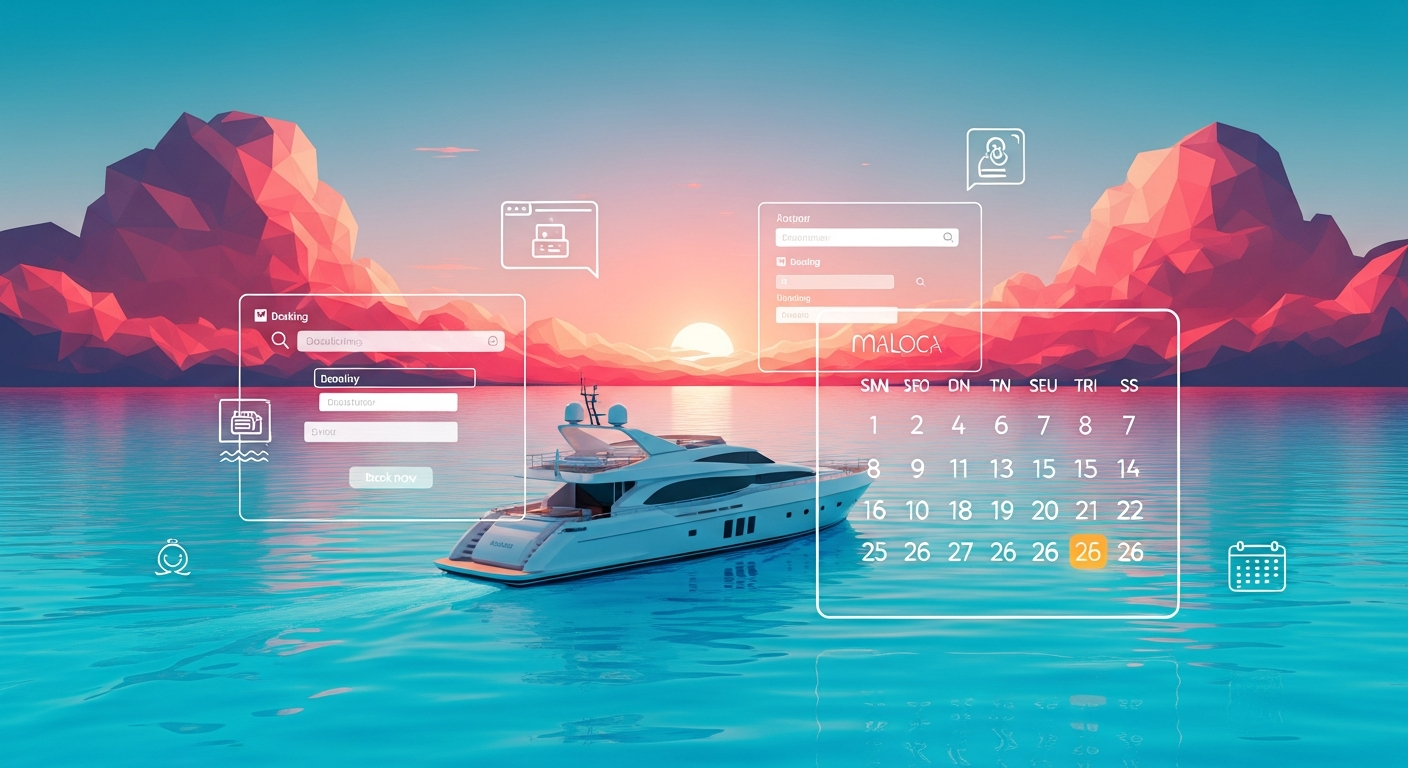
1. Real-time availability calendar
The single highest-impact feature. The user picks dates first, the site shows what's available. Not the inverse.
What works:
- Date-first homepage with a check-availability widget visible above the fold
- Visual calendar on each boat page with booked weeks blocked
- Multi-boat search — "show me what's available July 14-21 for 8 guests"
- Real-time sync to whatever fleet ERP the operator uses (Booking Manager, Sailogy, Nausys)
If your tech can't do this, fall back to a daily-updated calendar with a clear last-update timestamp.
2. Transparent total pricing
The price the user sees on the boat card should be the price they pay (within reasonable variance for fuel and tips).
What works:
- Base price visible on the card (the lowest weekly rate for the date range)
- All-in price calculator on the boat page: base + taxes + fuel estimate + crew + extras
- Currency switcher (EUR + GBP + CHF + USD minimum)
- Deposit clearly stated (typically 25-50% of total, refundable conditions)
The hardest sell: convincing operators to show prices. Many believe quote-only filters serious buyers. Data shows the opposite: in 2026, transparent pricing converts 2-4x better.
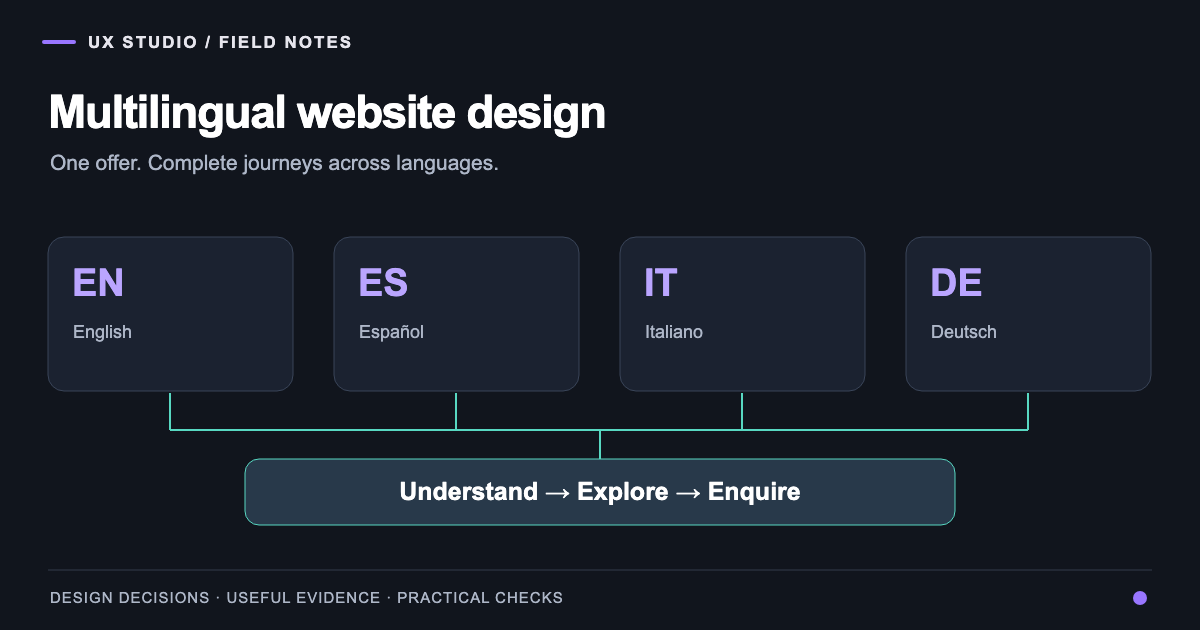
3. Multilingual UX as a foundation
For Mallorca charter, the language hierarchy is:
- English: 30-40% of bookings (UK + IE + Northern Europe + USA)
- German: 25-35% (Germany + Austria + Switzerland)
- Spanish: 15-20% (domestic + LATAM)
- French: 5-10% (France + Belgium)
- Italian: 5-10% (Italy)
Minimum: native EN + DE + ES. Recommended: add FR + IT for full coverage. Skip Google Translate — these audiences notice.
4. Photography and short vertical video on every boat
Charter is visual. Every boat needs:
- 20-40 high-quality photos per yacht (exterior, interior, cabins, dining, salon)
- Vertical 60-90s video showcasing key spaces and the experience
- Drone footage for boats over 60 feet (now expected)
- Floor plan / deck plan as a downloadable or interactive overlay
Cost reference: €1,000-3,000 per yacht for a full photo + video shoot. Pays back on the first booking.
5. Virtual tour for premium yachts
For yachts over 50 feet (especially crewed ones), a Matterport-style 3D tour or a polished 2-3 minute walkthrough video is now standard. It reduces unqualified inspections (good for the operator) and converts the serious buyer (good for both).
Cost: €500-1,500 per yacht. Pays back in reduced sales calls.
6. One-tap WhatsApp contact
In the Mediterranean, WhatsApp is the dominant charter inquiry channel. Make it one tap from every boat page, with a pre-filled message ("I'm interested in [Yacht Name] for [date range]").
Pair with: a fast response promise ("we respond within 30 minutes during business hours") and actually deliver. Charter buyers comparing options reward speed disproportionately.
7. Online deposit collection
Don't make the buyer email for bank details. Stripe or Mollie integration for partial deposit collection (10-30% to confirm) closes deals at the moment of intent.
For high-value bookings (€20,000+), still allow wire transfer as an option. But don't make it the default.
8. Visible safety and credential signals
Charter is high-trust. Display prominently:
- License number (Spain: TURISTICA license; Italy: codice navale)
- Insurance type (P&I, hull, third-party liability with coverage amount)
- Crew certifications (RYA, ASA, professional skipper licenses)
- Member organizations (MYBA, Charter Yacht Brokers Association, ECPY)
- Years of operation ("Charter operator since 2003")
- Reviews from past clients (Trustpilot, Google Reviews, embedded)
The buyer is wiring €30,000 to a Mediterranean operator they may have never met. Trust signals close the gap.
Common mistakes in yacht charter websites
- Hiding prices. "Request a quote" gets filtered out by sophisticated buyers in 2026.
- No real-time availability. If the user has to email to check dates, they'll check three competitors first.
- Stale photos. Photos from 2018 of boats that have since been refurbished are immediate trust killers.
- No mobile experience. A surprising number of charter sites are still desktop-first. Charter buyers research from phones.
- Generic "yacht template" sites. WordPress yacht themes look the same. Differentiation matters in a category where buyers compare 6-12 options.
- No clear cancellation/refund policy. High-value transactions need explicit terms, not buried legal pages.
Tech stack recommendations
For different operator sizes:
| Fleet size | Recommended stack | Typical budget |
|---|---|---|
| 1-5 boats | WordPress + RentABoat theme, manual updates | €5,000-12,000 |
| 5-20 boats | Lodgify or Hostaway with charter customization | €15,000-35,000 |
| 20-100 boats | Custom Next.js + headless CMS (Sanity, Payload) + ERP integration | €40,000-120,000 |
| 100+ boats | Custom platform with multi-tenant architecture, broker portal, API for partners | €120,000-500,000 |
Mallorca-specific considerations
- Peak season pricing logic: rates can swing 3-5x between low and peak season. Pricing engine must handle this dynamically.
- TURISTICA license display: Spanish regulation requires charter operators to display license numbers; some boats need ETV-equivalent licenses.
- Multi-base operators: many Mallorca operators run boats out of Palma, Port Adriano, Alcúdia, Mahón. The booking flow must let users filter by base.
- Currency mix: Germans book in EUR, Brits often in GBP, Americans in USD. Show at minimum EUR + GBP + USD.
- WhatsApp Spanish/German/English fluency: the customer service team responding via WhatsApp must be multilingual or use real-time translation.
How to evaluate a web partner for your charter business
The same general framework as any project, with charter-specific questions:
- Have you integrated with charter ERP systems (Booking Manager, Sailogy, Nausys, MMK)?
- Have you built multilingual booking flows for at least 3 languages?
- How do you handle real-time availability sync?
- What's your approach to multi-currency pricing display?
- Can you show me a charter site you've built that's currently live?
If they don't have charter-specific case studies, ask for the closest analog (vacation rentals, boutique hotels, time-based booking) and how they'd adapt.
If you operate a yacht charter business in the Balearics or wider Mediterranean and want a UX/SEO audit of your current site, we offer a free 30-minute consultation. We'll identify the biggest conversion leaks and propose a roadmap. No upsell — just an honest assessment from a studio working in the Mallorca market.
Frequently asked questions
About the author
Design & Engineering Team
The UX Studio design and engineering team publishes practical notes on digital strategy, user experience, accessibility and implementation. The articles draw on work documented in the portfolio, including EduSpera, ClassWolf and the SupaSailing / SupaMaritime ecosystem.